



Travel nursing is in high demand and offers premium pay in 2026. What you earn is calculated based on three factors: specialty, location, and experience.
Travel nurses make more money because they are needed. While staff registered nurses earn a median of $97,550 a year, there are not enough of them. The Bureau of Labor Statistics projects about 189,100 RN openings annually through 2034. This supply-demand gap drives up travel and contract rates above standard staff pay (U.S. Bureau of Labor Statistics).
Here's how the numbers break down, what's driving demand this year, and how you can tap into the premium pay rates.
What drives travel nurse pay rates
A travel nurse’s wages include a taxable base rate, similar to a permanent RN position. On top of that, it includes a tax-free stipend for housing and meals while on the road. What you don’t use, you get to take home.
The demand tied to the premium is structural.
According to HRSA's federal workforce analysts, national RN shortages will continue throughout the decade. When hospitals can't fill shifts locally, travel nursing contract roles fill the gap. For a deeper look into in-demand positions, see our overview of the most in-demand allied healthcare jobs in 2026.
Travel nurse pay by specialty
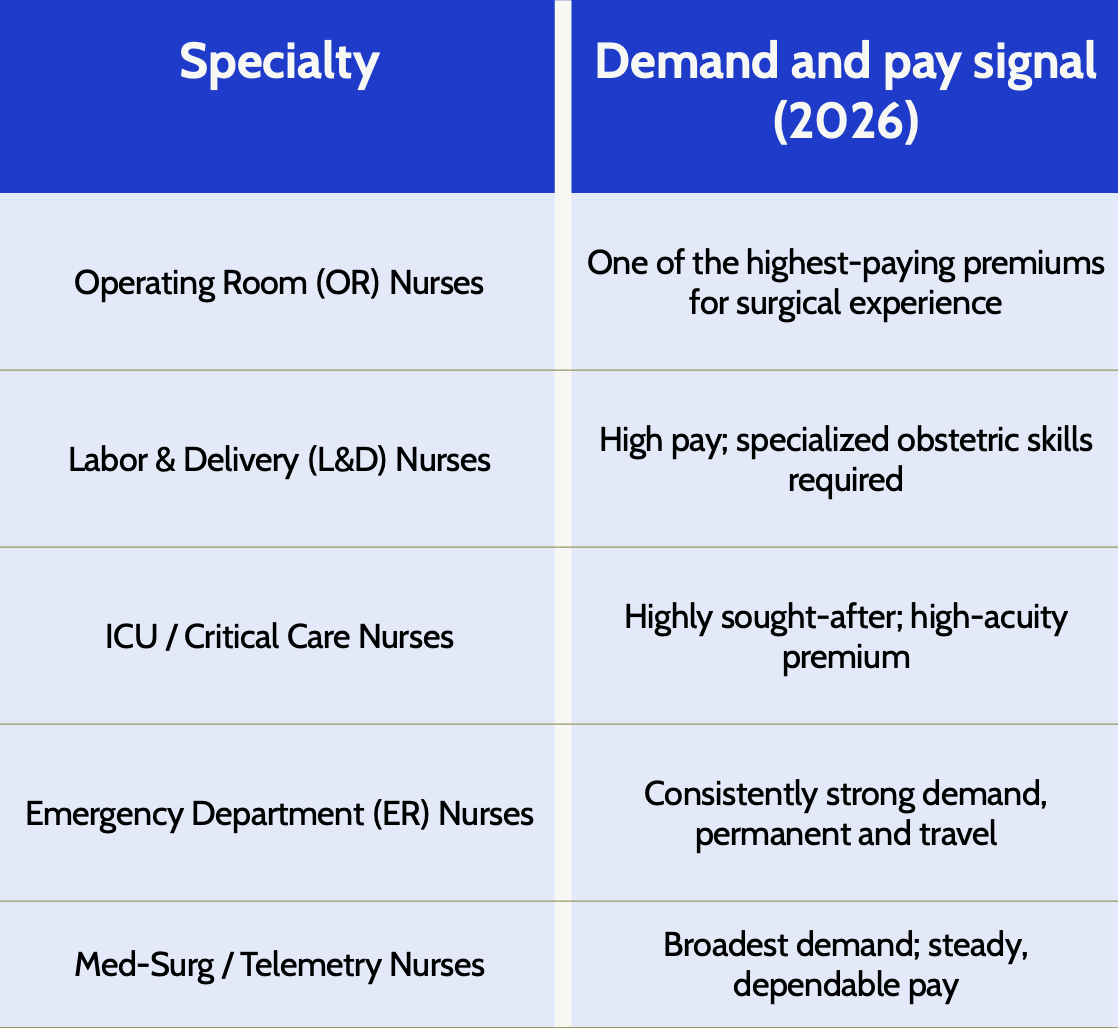
Specialty is what drives a good vs. great pay in nursing. High-acuity specialties (operating room, labor and delivery, ICU/critical care, and emergency) are known to command the highest contract rates because they require experienced clinicians who can perform at a high level with minimal training.
Med-surg and telemetry have the broadest demand and steady, reliable pay. You can explore open travel nursing roles by specialty on Prolink's travel nursing page.
Travel nurse pay by state
Location is the second biggest factor affecting travel nurse pay rates. Pay is calculated based on the cost of living and the severity of the local shortage. Rural communities have a higher demand than metropolitan areas.
The states with the largest projected nursing shortages, which now include California, North Carolina, Washington, Georgia, and Michigan per HRSA's December 2025 projections, carry the strongest contract demand (HRSA Health Workforce Projections).
California is a notable high-pay outlier twice over. It is included at the top of HRSA's projected-shortage list, and its mandatory nurse-to-patient ratio law creates constant, predictable demand. But it is not a compact license state, so you need a separate California license, which takes extra time (more on that below).
What actually boosts your paycheck
Beyond specialty and state, four factors increase your rate potential:
- Crisis and seasonal demand. Flu season, winter surges, and disaster response are hard to plan for and can trigger crisis pay well above standard rates.
- Experience and certifications. Most contracts require at least one year of recent specialty experience, while high-acuity units often prefer two or more.
- Stipend structure. Tax-free housing and meal stipends are tied to federal per diem rates for the assignment location, so the same base rate varies by city.
- Licensing speed. Being ready to start fast, with a license that is valid in multiple states, makes you more competitive for the best-paying contracts.
How to become a travel nurse
The path is straightforward:
- Become an RN (ADN or BSN) and pass the NCLEX-RN.
- Build specialty experience of at least 1 year in a high-demand area such as ICU, ER, OR, or L&D.
- Get licensed for mobility. A multistate compact license lets you accept assignments across participating states without re-applying each time. See our 2026 nursing compact states guide for the current state list and the 60-day residency rule.
- Partner with a recruiter to match your expertise and goals to the highest-value contracts.
Is travel nursing worth it in 2026?
For most experienced nurses, yes, travel nursing is worth it. The pay premium is real, and the demand will last for years to come.
You ultimately decide what’s worth it, depending on your specialty, the states you'll work in, and how quickly you can be ready to start. The nurses who earn the most pair an in-demand skill with license flexibility and work with a recruiter who knows how to find relevant high-paying contracts.
Connect with a recruiter to discover current travel contracts matched to your specialty and target pay.
Frequently asked questions about travel nursing
What is the foundation for travel nurse pay in 2026?
Staff RNs earn a median of $97,550 (BLS OEWS, May 2025), so a travel nursing contract will start there. But the rate increases because of a persistent national shortage, with about 189,100 RN openings projected each year through 2034 (U.S. Bureau of Labor Statistics).
Which travel nursing specialties pay the most?
Critical care specialties, including operating room, labor and delivery, ICU, and emergency, consistently command the highest contract rates due to the need for more experience and specific expertise.
Which states have the strongest travel nurse demand?
States with the largest projected nursing shortages, including California, North Carolina, Georgia, Michigan, and Washington, tend to carry the strongest demand (HRSA Health Workforce Projections).
How do I become a travel nurse?
Become an RN, gain about a year of specialty experience, get a multistate compact license for mobility, and work with a recruiter who can find you a good fit. Connect with a Prolink recruiter here.