



On the business side of a healthcare facility, you already know that every business decision is related to outsourcing in some way. Every cost conversion ties back to outsourcing. So what can you do with that knowledge?
Mordor Intelligence estimates the global healthcare business outsourcing market at roughly $449 billion in 2026, projected to reach $726.78 billion by 2031. Four service categories make up that number, with the fastest-growing sector of outsourcing in healthcare being workforce outsourcing.
What does BPO stand for in healthcare?
BPO stands for business process outsourcing. This means using a third party’s staff, technology, and process to run a defined business process on your behalf.
How does BPO differ from other means of outsourcing in healthcare? BPO is different from ITO (IT outsourcing), where a vendor manages your technology infrastructure, and from KPO (knowledge process outsourcing), where credentialed experts handle work like clinical research or legal review.
Healthcare BPO addresses staffing issues by having another entity handle high-volume, repeatable processes that don't need to live within your organization.
In practice, healthcare BPO could refer to everything from offshoring Medicare Advantage processing to managing a 400-person contingent nursing panel across a six-hospital healthcare system. The category is broad and encompasses all outsourcing programs in healthcare.
The four service categories of healthcare BPO in 2026
When discussing efficiency and savings, it’s common to divide healthcare BPO into three sections: provider services, payer services, and pharma/life sciences. One important industry is missing. A fourth category, workforce outsourcing, now accounts for a significant part of the budget and differs from the other three.
1. Provider services (RCM, claims, coding, prior authorization, AR)
This admin side of things comes to mind when people think of healthcare BPO. Revenue cycle management, medical coding, clinical documentation improvement, eligibility verification, prior authorization, denial management, accounts receivable follow-up, and payment posting are common processes to outsource.
Provider services drive revenue for the whole market. Precedence Research expects healthcare BPO to grow at a 9.07% CAGR through 2035, with patient-care services inside the provider segment growing fastest, at roughly 11%. The reason is that the demand for administrative work in U.S. healthcare systems is rapidly increasing, and hospitals simply cannot hire their way out of it.
2. Payer services (claims, member services, fraud, network management)
Administrative outsourced services on the payer side cover claims administration, member services, utilization management, fraud and abuse detection, and provider network management. Claims management takes up the largest chunk of payer services. Grand View Research puts it at more than 32% of healthcare payer BPO revenue, the largest application segment in the category.
The payer segment has its own cost pressure. KFF's analysis of 2023 ACA marketplace data found that insurers denied about 19% of in-network claims, roughly one in five. And when a claim is denied, more employees are required to manage complaints and appeals.
3. Pharma and life-sciences BPO (R&D support, clinical trial operations, regulatory)
The pharmaceutical segment represents one of the largest outsourced categories when sorting by revenue. Within life sciences BPO specifically, Grand View Research identifies pharmaceutical outsourcing, anchored by clinical trials, manufacturing, and contract sales work, as the largest share of money coming in.
Life sciences companies outsource pharmacovigilance, regulatory submissions, clinical data management, and R&D support to meet FDA and EMA requirements at a pace internal teams can't match.
4. Workforce outsourcing (MSP, VMS, RPO, contingent labor management)
Workforce outsourcing is just as important as these other categories. Without access to skilled and sufficient staffing, the whole health system can fail.
Managed services programs (MSPs) are all about outsourcing business processes to third-party companies that have their own systems in place. Under an MSP, the provider handles sourcing, recruiting, contract management, invoicing, payment processing, and workforce analytics. In turn, the entire contingent labor lifecycle gets run as a managed outsourced process.
For healthcare organizations, staffing cannot be outsourced in the same way that admin work can be. Clinical staff cannot be offshored. Your nurses, allied health professionals, and ED clinicians must live onshore, work on-site, and hold a state license.
That means workforce outsourcing has to be managed by a vendor with extensive US healthcare market knowledge. It is a different model from the offshore-heavy BPO that dominates provider and payer services.
Healthcare BPO market size in 2026
Finding the exact market size of healthcare BPO in 2026 isn’t easy, and results vary due to how each researcher sets the parameters. The table below compares four major research providers on their estimates of the healthcare BPO market size.
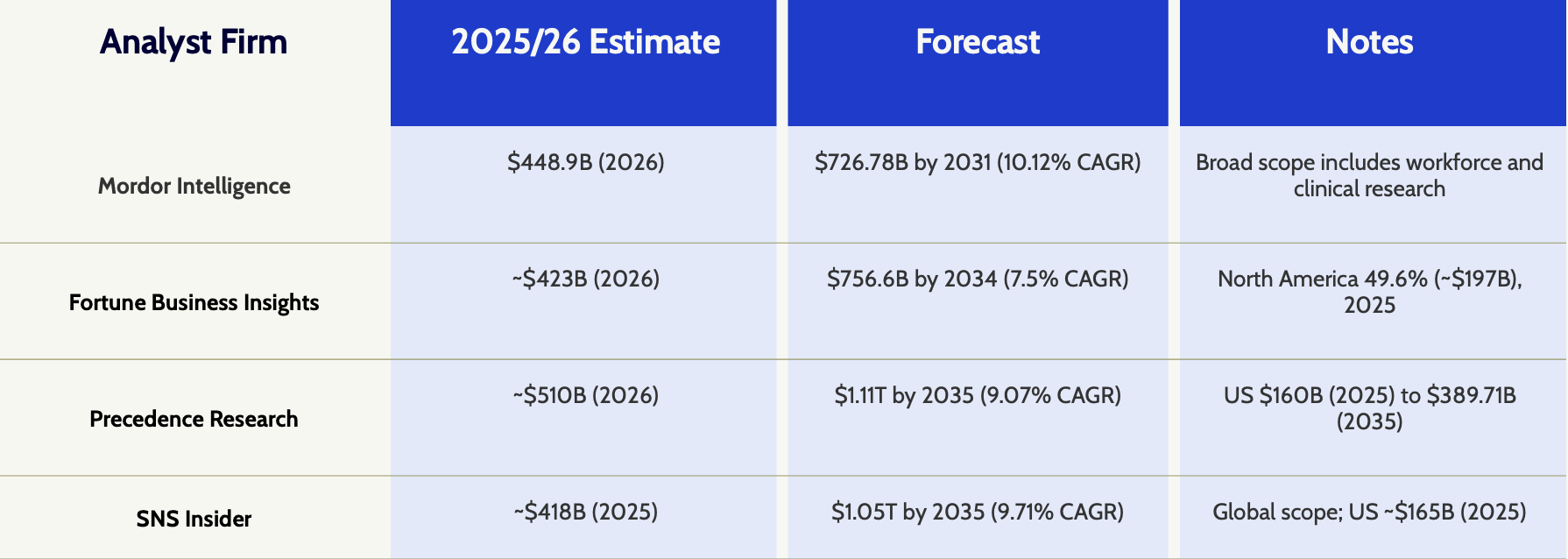
The highest estimates are from research firms that include pharma manufacturing and clinical research in the scope. Firms that focus on administrative and revenue cycle functions produce lower estimates. No estimate is wrong. They are measuring different slices of the same market.
The spread, from roughly $420 billion to $510 billion across recent estimates, reflects real methodological differences but still delivers the same message. Healthcare BPO is a booming business.
The data also show that North America dominates. Fortune Business Insights puts North America at 49.6% of global market share in 2025, roughly $197 billion. Precedence Research estimates the U.S. portion at $160 billion in 2025, growing to $389.71 billion by 2035.
Either way, the United States is the single largest healthcare BPO market on earth, and it is growing faster than the global average.
Why healthcare BPO is growing so fast
Healthcare BPO is growing so quickly as a result of three reasons. Each is significant on its own. Together, they make the growth trajectory durable rather than cyclical.
1. Margin compression and ever-increasing denial rates
US hospitals are operating on thin margins. Kaufman Hall's National Hospital Flash Report put the median hospital operating margin at 1.3% through December 2025. Labor accounts for nearly 60% of hospital operating expenses, per the AHA's 2025 Cost of Caring report. Every dollar of administrative inefficiency reflects on the bottom line.
Patients are more likely to get an insurance denial now. The HFMA/Guidehouse 2026 RCM Trends survey found that close to 20% of providers now report denials exceeding 5% of claims, up from 12% in a prior survey. Claim disputes bottleneck the system, causing inefficiencies that are hard to absorb. Payer denials and prior authorization delays rank as the top two RCM concerns, with 88% of respondents citing claim disputes as a barrier to getting paid.
Turning over denial management and AR processes to an outsourced company is common to handle the influx of calls and appeals and speed up the payment process.
2. Persistent staffing constraints
Healthcare staffing continues to be a pressing issue. An AAPC report finds 63% of providers reporting RCM staffing gaps, and other industry survey work consistently finds roughly two-thirds of healthcare organizations reporting RCM positions they cannot fill.
Areas that are consistently understaffed include coding, CDI, and prior authorization teams. Health systems that cannot recruit internally are outsourcing the work to vendors who already have the capacity and processes.
3. AI maturity making outsourced operations more cost-effective
AI increases cost savings in outsourcing instead of helping entities save more money by hiring in-house. The National Bureau of Economic Research estimates that broad AI adoption across US healthcare could generate between $200 billion and $360 billion in annual savings (5 to 10% of total spending). Yet nearly 60% of healthcare organizations have not implemented AI or automation in their revenue cycle.
Instead of learning a whole new technology, healthcare organizations choose to outsource to a third party who already has the process in motion. Specialized BPO vendors are deploying AI tools, including autonomous coding, predictive denial prevention, and intelligent authorization workflows, faster than most health systems can build them internally.
This is part of why 70% of hospitals plan to expand their RCM outsourcing over the next year, according to the same survey.
What hospitals outsource most in 2026
Coding and billing are not the only areas where outsourcing reigns in healthcare in 2026. Becker's Healthcare and Savista's 2025 RCM Benchmark Survey reports that 97% of healthcare organizations now outsource at least one RCM function to a third-party provider. Instead of asking whether it’s time to outsource, the questions are about which processes to outsource and to whom. Outsourcing is a must either way.
Functions that are commonly outsourced in healthcare include:
- Revenue cycle: Medical coding, CDI, prior authorization, eligibility verification, denial management, AR follow-up, payment posting, billing, and enrollment
- Payer-side: Claims administration, member services, fraud and abuse detection, and care coordination support
- Compliance and audit: Regulatory compliance functions, audit services, and risk management
- Workforce management: Contingent labor sourcing, credentialing, supplier panel management, and VMS/MSP program administration
Some healthcare organizations are just beginning the conversation on workforce outsourcing. Most have already outsourced coding. Fewer companies have made the decision to outsource staffing and management of clinical staff to a healthcare MSP. Prolink is ready with industry-specific solutions.
The largest healthcare BPO companies and their primary services
The healthcare BPO business playbook includes global generalists and clinical specialists. They do not compete in the same categories.
- Optum (UnitedHealth Group) operates across payer services, provider services, and data analytics, with one of the broadest footprints in the industry.
- Conduent and Omega Healthcare operate primarily in provider-side RCM, coding, and eligibility.
- Cognizant focuses on provider-side services, analytics, and digital transformation. In Q2 2025, Cognizant announced two $1 billion-plus total contract value mega-deals tied to AI productivity gains, per Cognizant's SEC filings.
- Genpact and Accenture play in both healthcare and broader enterprise BPO, with healthcare divisions focused on RCM, claims, and compliance.
- NTT Data has deepened its clinical services play, including a 2024 collaboration with Duke Health on a new model of in-home care that integrates Ellipsis Health's generative AI tools.
These big healthcare BPO players handle many processes, but none include workforce outsourcing for clinical staff. That is a different category, and it takes US-based delivery, real clinical credentialing expertise, and live market intelligence on compensation and supply.
Healthcare BPO Vs. healthcare staffing agencies
The two terms, healthcare BPO and healthcare staffing agency, are at times used interchangeably. They shouldn't be.
Healthcare staffing is the practice of finding and hiring qualified individual clinicians (nurses, allied health professionals, physicians) to fill open roles. The staffing firm fills the open position. After that, the healthcare organization takes over.
In contrast, healthcare BPO takes on the process from start to finish. The vendor owns workflow, compliance, reporting, and outcomes. Not just candidate delivery.
MSP sits at the intersection. Under an MSP model, a vendor manages your entire contingent workforce program (supplier coordination, invoicing, credentialing, rate benchmarking, and analytics) as a managed outsourced service. By the standard industry definition, the MSP arrangement is BPO applied to workforce management.
So, do you need a staffing agency or a healthcare BPO? If you are spending $50 million a year on travel nurses and agency labor with no organized management, you are not really getting staffing. You are getting a fragmented process that often leaves you in the lurch, no matter how much you spend. An MSP converts staffing services into managed, measurable results.
For a more detailed comparison, see our breakdown of the benefits of MSPs.
Onshore vs. nearshore vs. offshore
Does outsourcing always mean using staff from other countries? That can’t always be true when hiring staff certified to work in the US at a hospital or healthcare facility.
For healthcare BPO, offshore delivery still anchors the model. Mordor Intelligence reports offshore operations made up about 59% of healthcare BPO revenue in 2025, anchored by India and the Philippines.
However, a surge is happening on the nearshore side, the fastest-growing delivery model. Market Data Forecast projects Latin America's healthcare BPO market more than doubling, from $22.98 billion in 2024 to $53.52 billion by 2033, a 9.85% CAGR led by Brazil and Mexico.
HIPAA data residency requirements and time-zone alignment make Latin America more convenient for real-time prior authorization, denials work, and bilingual member services.
Finding clinical staff to work on-site requires a completely different model. Bedside nursing, ED staffing, and credentialed clinical roles require US-licensed professionals, on-site delivery, and PHI access that cannot legally or practically move offshore.
Staffing remains onshore, outsourced to companies with an in-depth knowledge of US employee regulations.
Risks and trade-offs for healthcare leaders considering outsourcing
Outsourcing reduces workload. That doesn’t mean the healthcare system is not ultimately responsible for compliance.
Your organization remains accountable for HIPAA compliance, patient data integrity, and regulatory obligations regardless of which vendor runs the function.
Key risks to assess before signing a BPO contract:
- HIPAA and data residency restrictions. Personal health information handled offshore is subject to data residency rules that vary by jurisdiction. Florida's data residency law requires electronic health records to stay within the United States, its territories, or Canada. Several other states are working on similar legislation.
- Geopolitical changes and visa risk. U.S. visa policy changes affecting Indian healthcare BPO talent, combined with broader U.S.-China technology restrictions, are reshaping offshore delivery economics. Organizations heavily dependent on a single offshore hub are exposed.
- AI governance gaps. The Censinet 2025 Healthcare Cybersecurity Benchmarking Study found that roughly 72% of healthcare breaches involve a vendor or third party. Just because you outsource the work doesn’t mean you have to answer for the mistake made by your third-party partner. When a BPO vendor deploys AI in your revenue cycle or coding workflows, you need clarity on who owns model governance, audit trails, and error remediation.
- Vendor monopoly risk. Running multiple critical functions through a single BPO vendor creates a single point of failure. A tiered, multi-vendor approach adds complexity but distributes risk.
The right BPO partner mitigates these risks through contract design, transparency, and compliance infrastructure.
How to choose a healthcare BPO partner
You should be asking these five questions before hiring a healthcare BPO for workforce outsourcing.
1. What process do you need to outsource?
The answer determines everything else. "RCM" is too broad. "Denial management for commercial payers on claims over $10K" is actionable. The more clearly you define what you need, the more accurately you can evaluate vendor capability.
2. Does the function require U.S. licensure or PHI residency?
Clinical roles, credentialing, and anything touching PHI in certain jurisdictions cannot go offshore without significant compliance exposure. Evaluate these restrictions before looking at offshore outsourcing.
3. Is the vendor familiar with the industry and experienced in the specific process?
A global BPO firm with a healthcare practice is a different thing from a firm built exclusively for health system operations. Generalists bring scale. Specialists bring depth. If the process needed is more complex, choose a specialist firm.
4. What is the plan with AI usage, and who owns governance?
With AI workflows now standard among leading BPO vendors, you need to ask which models are in use, how they are validated, and if they take responsibility when the model is wrong.
5. Can the third-party provider handle fluctuations in demand?
Healthcare labor demand spikes during flu season, census surges, and open enrollment. Signing a contract with a flat monthly rate does not mean the needs will be the same each month in healthcare. Build a contract on this transparency and produce a plan that works for both sides.
Where Prolink's ProMSP fits as a healthcare workforce BPO
Prolink provides workforce outsourcing for healthcare companies needing more than just the staff to fill open positions. Our position is often overlooked but extremely vital in healthcare BPO.
ProMSP operates as a managed services program. We handle contingent labor sourcing, supplier panel management, credentialing, and market-rate benchmarking as a fully outsourced program.
Our infrastructure pulls from more than 250 competitor data sources, so your workforce leaders can stay competitive with what the market is really paying.
Our success and experience are in the case studies. For a six-site health system, we centralized program management across a complex hospital network and delivered an estimated $5 million in 2025 contingent labor savings with 100% float pool staffing.
Frequently asked questions about healthcare BPO
What is healthcare BPO?
Healthcare BPO (business process outsourcing) is the practice of contracting third-party specialists to run defined administrative, clinical-support, or workforce functions for hospitals, payers, and pharmaceutical companies. It covers everything from medical coding and claims processing to contingent workforce management and clinical trial support.
What does BPO stand for in healthcare?
BPO stands for Business Process Outsourcing. In healthcare, the term applies to any third-party vendor that runs a defined operational function end-to-end, including revenue cycle management, payer services, pharmaceutical R&D support, and managed workforce programs.
How big is the healthcare BPO market in 2026?
Analyst estimates for the global healthcare BPO market in 2026 range from approximately $423 billion to $510 billion, depending on how each research firm defines the category. Other estimates place the market at $448.9 billion, with projections reaching $726.78 billion by 2031. The United States accounts for roughly half of global market volume.
Is managed services (MSP) considered a type of healthcare BPO?
Yes. By standard industry definition, a Managed Services Program (MSP) is a form of BPO. Rather than placing individual workers, an MSP manages the entire contingent workforce lifecycle, including sourcing, credentialing, supplier management, compliance oversight, and workforce analytics as a managed outsourced process.
What are the biggest risks of healthcare BPO?
The primary risks include HIPAA and data sovereignty exposure, AI governance gaps in outsourced workflows, geopolitical and visa-related risks affecting offshore delivery hubs, and vendor concentration. Importantly, outsourcing transfers the workload—not the compliance responsibility. The healthcare organization remains the covered entity and retains accountability for regulatory compliance.
Why are so many hospitals expanding BPO in 2026?
Three major factors are driving healthcare BPO growth, and they are margin pressure, persistent staffing shortages, and AI-enabled efficiencies. Median hospital operating margins remain around 1.3%, approximately two-thirds of healthcare organizations continue to report revenue cycle management staffing constraints, and specialized outsourcing providers are deploying AI-driven automation faster than many health systems can build internally. As a result, industry surveys indicate that approximately 70% of hospitals plan to expand RCM outsourcing initiatives in 2026.
Get ahead of your healthcare workforce challenges with ProMSP
Outsourcing is here to stay, and you get to decide if you actually save money while implementing outsourced services. Healthcare BPO is a $448.9 billion market built on provider services, payer services, pharma and life sciences, and workforce outsourcing.
The first three get most of the attention in market reports. The fourth, managing contingent clinical labor as a fully outsourced program, is an opportunity for you to get ahead on workforce management in your healthcare organization.
If your health system is ready to apply managed services to workforce operations, see how Prolink's ProMSP delivers savings and efficiency.