



When talking about healthcare BPO, a managed services program (MSP) is often missing from the conversation. Business process outsourcing (BPO) often includes coding, pre-authorization teams, and billing. But outsourcing your staffing problem is just as vital.
And MSP has quietly become one of the fastest-growing parts of healthcare BPO.
Mordor Intelligence puts the broader market at $448.9 billion in 2026, on track for $726.78 billion by 2031, and MSP healthcare staffing is pulling more than its share of that growth.
Here is why the categories overlap, and how to know which model your health system actually needs.
Learning the healthcare language
Before comparing models, agree on what each term means. These categories get conflated, and the confusion costs health systems real money when they pick the wrong vendor structure.
What is healthcare BPO?
BPO is handing over a full business process to a third party. It often occurs with billing, coding, credentialing, claims, etc. The vendor runs the process from start to finish on your behalf, using their staff, tech stack, and organizational structure.
What defines BPO is more about who owns the outcome. The accountability moves to the vendor, and the pressure is on them to deliver what they promise. Mordor Intelligence has the global healthcare BPO market growing at a 10.12% CAGR through 2031, pushed along by cost pressure and a widening staffing gap.
What is a healthcare MSP?
Healthcare MSP is also done by a vendor who manages end-to-end contingent workforce management. The MSP handles supplier sourcing, contract negotiation, credentialing, time and attendance, rate benchmarking, compliance, and reporting across every staffing vendor your hospital uses.
You govern the process, but the details are all worked out through the MSP. Demand forecasting, credential verification, and delivering the right number of staff to serve patients while minimizing costs are off your shoulders.
That is a textbook BPO arrangement. The only variable is which business process is being outsourced.
What is a VMS (Vendor Management System)?
A VMS is software, not a service. It provides order management, vendor tracking, time capture, and reporting for contingent labor. A VMS can sit inside an MSP program or run independently inside your workforce team.
Mixing up VMS and MSP is one of the most common buyer mistakes we see. You can use a VMS platform as the tool, and the MSP is the team and managed service that actually runs it.
What is RPO (Recruitment Process Outsourcing)?
It’s standard procedure to hire a recruiter to find top talent for open healthcare positions. RPO outsources the recruiting function for permanent hires, including sourcing, screening, offer management, and onboarding. Unlike MSP, RPO usually focuses on full-time employees rather than contingent clinical staff.
In practice, large health systems often run MSP and RPO in parallel. MSP governs agency and traveler supply. RPO governs direct-hire pipelines.
Why MSP is considered a healthcare BPO service
In the staffing industry, an MSP is a workforce-specific form of BPO. The defining characteristic of BPO is that an external vendor assumes responsibility for an end-to-end business process.
That is how a healthcare MSP works for contingent workforce management. It manages the vendor panel, enforces rate discipline, owns the compliance calendar, and delivers consolidated reporting.
What an MSP does not do is provide direct patient care or make clinical judgment calls. Neither does a revenue cycle BPO make coding decisions on behalf of physicians.
The vendor manages the process around those decisions. The distinction between MSP and traditional BPO is process domain, not category.
Leaders in healthcare organizations exclude MSPs when looking for opportunities to expand their healthcare BPO. They end up evaluating only RCM and back-office vendors.
That is a mistake with real consequences because the healthcare staffing crisis driving this growth is not a back-office problem. It is a front-line operational one.
MSP vs. BPO vs. VMS vs. RPO
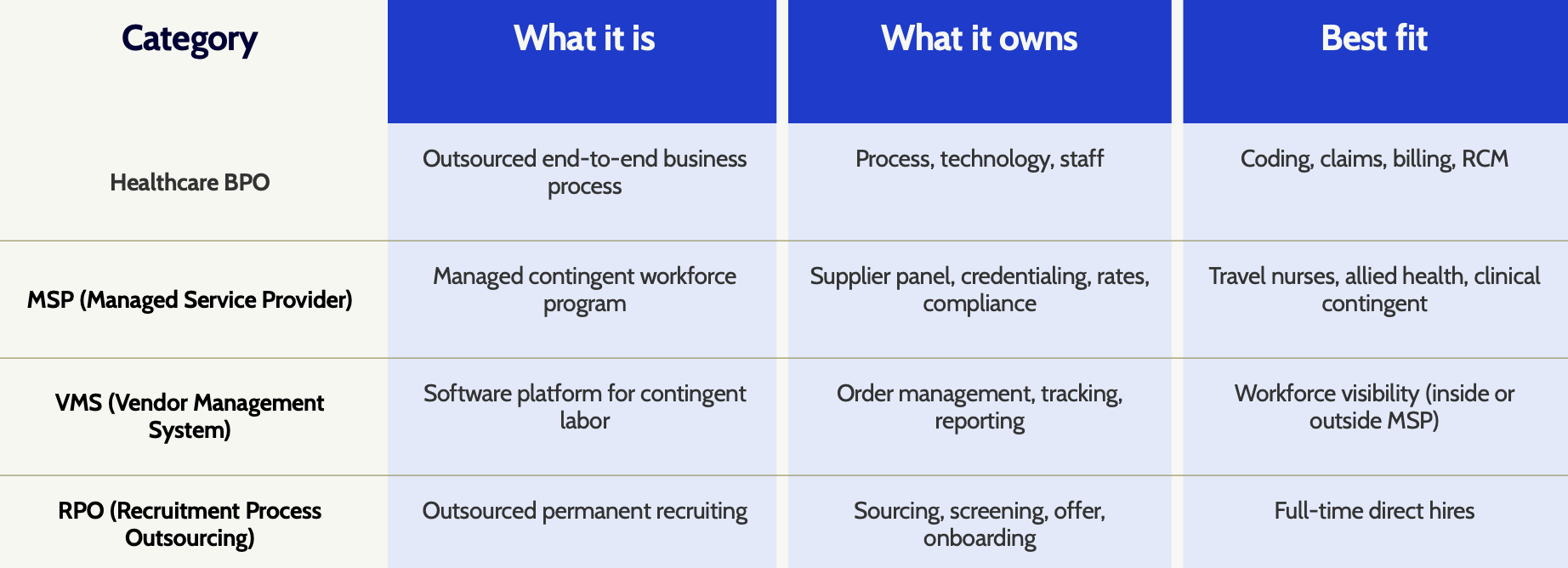
MSP and traditional BPO do not overlap in the same workflow markets. You can hire an MSP to manage your traveling nurse program while also using a BPO vendor for back-office administration work. Your efforts are not overlapping. You are maximizing the benefits of BPO by implementing multiple categories.
Why workforce outsourcing is the fastest-growing healthcare BPO category
The growth stats tell what the future holds in healthcare BPO. Fortune Business Insights projects North America alone at 49.6% of that global share, and Precedence Research estimates the US market at approximately $160 billion in 2025.
Within that market, workforce outsourcing is under pressure from two directions.
- Supply constraints: AAPC research and Becker's Hospital Review coverage put about 63% of providers reporting RCM staffing constraints. That number likely understates clinical workforce shortfalls, which are harder to quantify but operationally more urgent.
- Demand acceleration: The HFMA/Guidehouse 2026 RCM Trends survey finds 70% of hospitals plan to expand outsourcing in the next cycle. Outsourcing is an economical way to leave solutions to the experts who specialize in back-office work, allowing healthcare organizations to focus on serving patients. Meanwhile, clinical workforce teams remain understaffed, leading to more money wasted on last-minute contingent staffing. An MSP can mitigate that wasted money by forecasting demand and providing the necessary staff at the right times.
- Supply-side gap: Staffing Industry Analysts and Everest Group's MSP PEAK Matrix research both flag that legacy MSP models were built to save money in stable markets, not to support the high demand for clinical credentialing in a supply-constrained environment. The market is growing fast, but not every MSP model is equipped to capture the clinical complexity that growth represents.
What a modern healthcare MSP delivers
A modern healthcare MSP does not just find your clinicians for you. They are involved in the day-to-day to make the hiring and retention process more efficient.
- Supplier panel design and governance. A mature MSP does not just aggregate vendors. It structures the panel for coverage, redundancy, and rate control. Tier-one suppliers handle volume. Specialty suppliers handle hard-to-fill categories. Panel governance sets performance floors and exit criteria.
- Market-rate benchmarking. Prolink's ProMSP pulls from more than 250 competitor data sources to build a real-time market-rate dashboard. Clients pay market, not panic pricing, during surge events. Rate discipline at scale requires external reference data. Internal HR teams rarely have it.
- Credentialing automation. Clinical credentialing is the bottleneck that kills time-to-fill. A competent MSP owns the credentialing workflow (primary source verification, license checks, facility-specific onboarding requirements) and compresses the timeline through process standardization, not shortcuts.
- Volume-flex contracts. The MSP negotiates master service agreements that allow volume to flex without renegotiation. Census spikes, seasonal surges, and regulatory-driven staffing ratios all require elasticity that fixed contracts cannot provide.
- Compliance ownership. Professional standards like the Joint Commission, CMS conditions of participation, state-specific nurse staffing ratios, and pay transparency laws. The MSP carries compliance accountability across the entire contingent workforce, not just its own placements. That matters for health systems running across multiple states.
- Real-time reporting. Consolidated dashboards give your workforce leaders visibility into spend, fill rates, time-to-fill by role, and vendor performance. Every supplier in the panel, in a single view. AI in MSP and workforce operations is accelerating this reporting layer further.
Put those capabilities together, and you have a managed business process. That is what separates an MSP from a staffing agency. It is accountable for outcomes, not just for filling seats.
When MSP wins over traditional BPO
Sometimes it makes sense to bring on an MSP. And other times it’s more cost-effective to go the traditional BPO route. But knowing when to make the right choice prevents expensive detours.
Pick MSP when:
- Clinical roles are a big part of your contingent labor budget
- Credentialing is complex (travel nurses, advanced practitioners, allied health)
- You operate multiple sites with fluctuations in demand
- Contingent labor exceeds 15% to 20% of total clinical workforce
- You have lost rate discipline across a fragmented vendor panel
- Time-to-fill on clinical roles is a bottleneck, affecting patient access or quality metrics
Pick traditional BPO when:
- The admin work happens behind the scenes, like coding, claims processing, prior authorization, and billing
- Clinical judgment is not a need in the roles
- Personal health information is not at risk of falling into the wrong hands through standard data security agreements
- Cost reduction per unit processed is the primary metric
Choose both in a hybrid model
It is very possible to choose an MSP for your contingent workforce program and a traditional BPO for administrative duties. Most modern health systems are already doing this.
A VMS platform provides spend visibility across both. The strategic question is not MSP or BPO. It is about integrating governance across both so that reporting, compliance, and accountability do not fall through the cracks between them.
Market Data Forecast pegs Latin America's healthcare BPO market on a path from $22.98 billion in 2024 to $53.52 billion by 2033, a 9.85% CAGR. The hybrid model is scaling internationally for back-office work while domestic MSP holds the clinical core.
The Prolink ProMSP model
If you’ve learned about MSPs before, you may think of manufacturing, retail, and other industries that experience an influx of demand during certain seasons. Most legacy MSPs are designed to accommodate high-volume, low-complexity, and price-sensitive staffing. Healthcare is different.
Credentialing requirements are stringent. Clinical roles require real-time qualification verification.
The cost of a fill failure is not inventory disruption. It is a patient safety risk. Staffing Industry Analysts and Everest Group have both noted that legacy MSPs were not built for this environment.
Prolink's ProMSP is structured around clinical workforce accountability from the ground up. Our supplier governance model, rate benchmarking infrastructure, and credentialing workflows are built specifically for health system complexity. Not retrofitted from a different industry.
The operational record supports this. For a six-site health system, we unified a fragmented supplier panel across multiple facilities, restored rate discipline, and delivered projected $5 million in 2025 contingent labor savings with 100% float pool staffing.
We won’t try to replicate these exact results with your health system—not because they’re impossible, but because we know that every hospital needs something different to succeed. When you bring on ProMSP as your provider, we get to know your exact challenges, strengths, and opportunities, and use them to craft the workforce solution that suits you best.
Frequently asked questions about healthcare MSPs and BPO
What is the difference between MSP and BPO in healthcare?
BPO is the broad category: Outsourcing an end-to-end business process to an external vendor. MSP is a specific type of healthcare BPO that manages contingent workforce operations: Supplier governance, credentialing, rate benchmarking, compliance, and reporting. Traditional BPO typically covers back-office functions like revenue cycle, coding, and claims.
Is a managed services program (MSP) a type of healthcare BPO?
Yes. By standard industry definition, an MSP is a workforce-specific form of BPO. An MSP assumes responsibility for contingent workforce management on behalf of a hospital, which is the defining characteristic of any BPO arrangement.
What does an MSP actually do in healthcare staffing?
A healthcare MSP manages the full contingent workforce lifecycle. It designs and governs the supplier panel, benchmarks market rates, owns credentialing workflows, negotiates volume-flex contracts, and delivers consolidated compliance reporting. It is a managed business process. Not a staffing agency with a technology layer.
What is the difference between MSP, VMS, and RPO in healthcare?
MSP is a managed service: A vendor runs contingent workforce operations on the hospital's behalf. VMS is software that provides order management and spend visibility, and can operate within or outside an MSP structure. RPO outsources recruiting for permanent hires. Most large health systems use all three in combination.
Why is healthcare workforce outsourcing growing faster than traditional BPO?
Clinical staffing constraints are persistent and acute. AAPC and Becker's coverage put about two-thirds of organizations facing staffing constraints, and the HFMA/Guidehouse 2026 RCM Trends survey finds 70% of hospitals plan to expand outsourcing. Internal workforce teams cannot absorb that pressure. MSP programs provide the infrastructure to manage it at scale.
When should a health system use an MSP instead of managing staffing internally?
MSP becomes the better choice when contingent labor represents a meaningful share of clinical staffing (typically 15% to 20% or more), when credentialing complexity is high, when multiple sites create coordination challenges, or when rate discipline has eroded across a fragmented vendor panel. Internal management works at low volume. MSP creates leverage at scale.
Is your current system or MSP built for clinical complexity?
It doesn’t have to be MSP or BPO. MSP is a part of the healthcare BPO ecosystem as a whole. It is the workforce-outsourcing slice of a much larger market. So, the real question is not whether MSP belongs in the BPO conversation. It is whether your MSP was actually built to handle clinical complexity at the scale your health system needs. Modern MSPs are a genuinely different kind of partner who carry real accountability for rate discipline, credentialing infrastructure, multi-site governance, and compliance ownership.
Ready to compare ProMSP against your current staffing and vendor management structure? Click below to see how the ProMSP model maps to your specific workforce challenges and to connect with a workforce expert today.